
The Bin Test You Outsourced
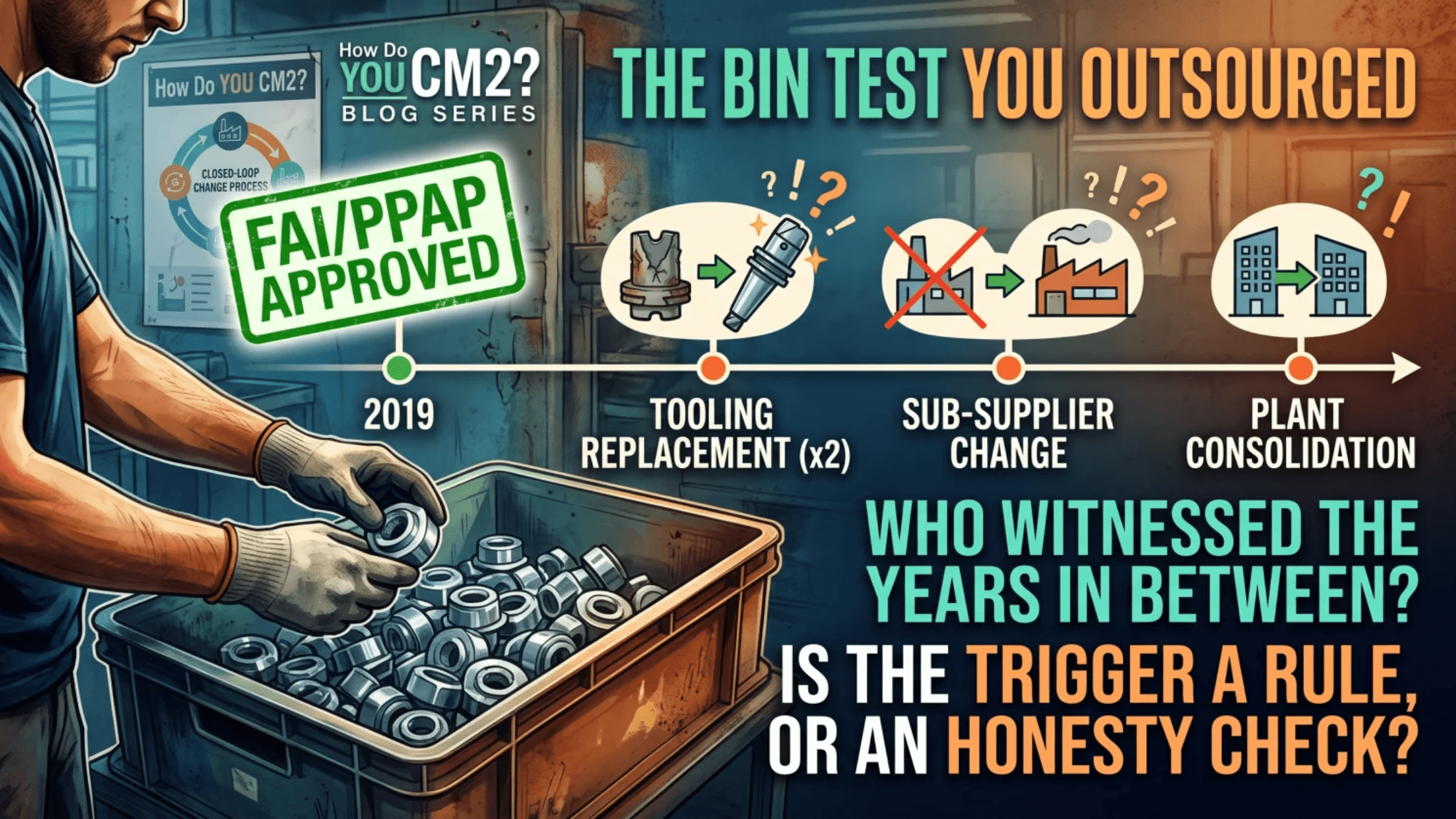

Your supplier ran a flawless first article inspection in 2019. Since then: two tooling replacements, a sub-supplier change, and a plant consolidation. The part number never changed. Who witnessed any of it?
When production crosses a company boundary, industry institutionalized the demonstration long ago. Aerospace calls it First Article Inspection (FAI), governed by AS9102. Automotive calls it Production Part Approval Process PPAP. Strip away the forms, and both are the same idea: before the claim stands, prove that the process reproduces the design intent.
And notice something remarkable: neither regime fires only on new part numbers. AS9102 requires FAI re-accomplishment for process changes, new tooling, a relocated production line, changed inspection methods, or a production lapse of more than two years, with a partial “delta” FAI covering the affected characteristics. PPAP requires customer notification and re-approval for process changes, relocations, and sub-supplier changes. These are among the very few mechanisms in industry that demand a demonstration precisely for the claim that nothing changed. “This is still the same part” gets evidence, a scope, and a witness, not a checkbox.
And yet. Both regimes are strongest on the day the claim is born and weakest during the decades it must hold. Between demonstrations, the customer’s confidence rests on the supplier recognizing that a trigger fired and volunteering it. A declaration from the party with the least incentive to make it.
The two industries even answer the witness question differently. Aerospace FAI is customer notification: the package is submitted, and the customer reviews it. PPAP is customer-gated approval: no production without an explicit approved status. Two answers to “who witnesses the supplier’s demonstration?” Neither answers “who witnesses the years in between?”
Which is why supplier realization changes belong inside the closed-loop change process as first-class change events, not as quality-department paperwork. Co-producers are part of the configuration. Their process changes are configuration changes.
So, for your longest-running supplier part: when was interchangeability last actually demonstrated? And is the re-demonstration trigger a rule your systems enforce or your supplier’s honesty? Let me know what you think.
Ready to go deeper?
Use code Martijn10 for 10% off training—and don’t forget to tell them Martijn sent you 😉.
Copyrights by the Institute for Process Excellence
This article was originally published on ipxhq.com & mdux.net.