
PLM and Digital Tools Selection
A PLM tool won’t fix a broken process — it will automate it, faster, and put it on a nicer dashboard. Nobody wants bad data delivered faster. IPX helps you choose the right digital tools and implement them successfully, starting from your processes rather than a vendor’s feature list including when you haven’t selected a tool yet. PLM | RMS | CPQ | PDM | MES | CAD | BI | DATA LAKES

PLM & Digital Tools Selection
Processes lead. Tools follow.
A PLM tool won’t fix a broken process — it will automate it, faster, and put it on a nicer dashboard. Nobody wants bad data delivered faster. IPX helps you choose the right digital tools and implement them successfully, starting from your processes rather than a vendor’s feature list including when you haven’t selected a tool yet.
PLM | RMS | CPQ | PDM | MES | CAD | BI | DATA LAKES
Tools are process agnostic
PLM and the systems around it are exceptionally good at automating, ordering, and reporting data at scale. What they can’t do is tell whether the process feeding them is sound. Point one at flawed processes and you get poor-quality data produced faster and presented better and still needing manual correction to mean anything.
We treat these tools as participants in your business process, not standalone solutions.
Our methodology
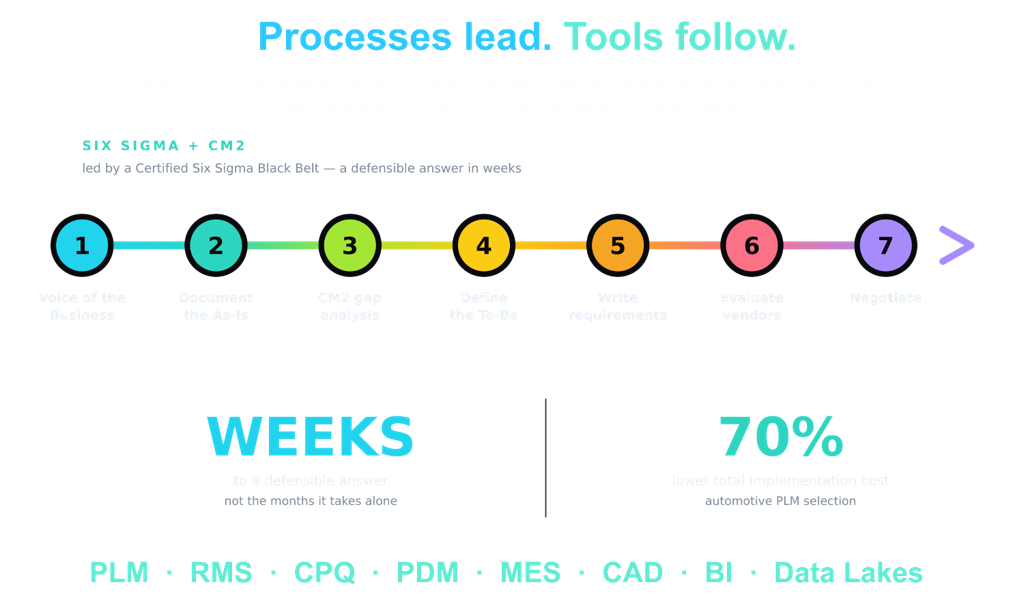
Led by a Certified Six Sigma Black Belt, combining Six Sigma with CM2, which is how we reach a defensible answer in weeks rather than the months it typically takes alone:
- Listen to the Voice of the Business. Structured stakeholder interviews, with themes and relationships surfaced through KJ analysis.
- Document the As-Is. How work actually happens, from the people doing it, documented procedures and the practical knowledge behind them, plus system utilization and resource allocation.
- Run a CM2 gap analysis. Measure current state against CM2 core business processes, then prioritize the gaps into a roadmap.
- Define the To-Be. A future state aligned to your goals, with genuine stakeholder consensus behind it.
- Write the requirements. Functional requirements and business use cases in “I want / so that / acceptance criteria” format — precise enough to prevent scope creep and get accurate vendor quotes. Our tool certification experience means they are achievable, and even out-of-the-box tools need configuring.
- Evaluate vendors and integrators. A structured, objective evaluation that filters out provider bias: discovery, scenario responses, live demonstrations scored against your To-Be process, the proposed deployment team, and the integrator’s business process acumen.
- Negotiate. Using cross-industry knowledge of what these deals should actually cost.
Requirements gathering is not brainstorming in Word.
Proof: automotive PLM selection
The client had already chosen Teamcenter and a top-tier integrator, and wanted the decision validated. IPX applied Six Sigma methods and CM2 best practices to assess current state, define future processes, and build a requirements framework for a quantitative evaluation of Teamcenter against two other leading options.
IPX negotiated total implementation cost down by 70%, matching the lowest quoted price.
We stayed on through configuration and launch, writing step-by-step procedures covering both their processes and the tool itself, more effective than standard out-of-the-box training, and ran a train-the-trainer program so the team became self-sufficient.
Selection is the easy part
We stay tool-agnostic and work alongside your system integrator, so your enterprise knowledge actually reaches the build. Then we handle the change management and training that decide whether people adopt the tool, establish a single source of truth with disciplined metadata management so everyone works from the same numbers, and stay on afterward to sustain and improve what we built.
Why bring in a third party
An outside expert has no internal politics to protect. You get an objective read, specialized experience from across industries, and a project run by someone whose only job is running it while your team stays on their own work.
Ready to get started?
Let's start with a conversation about where your organization is today and where the CM2 framework can take you.