
Model-Based Systems Engineering
Build requirements traceability that holds from design through build, supply chain, and service so you know what every change affects before it happens.

Model-Based Systems Engineering
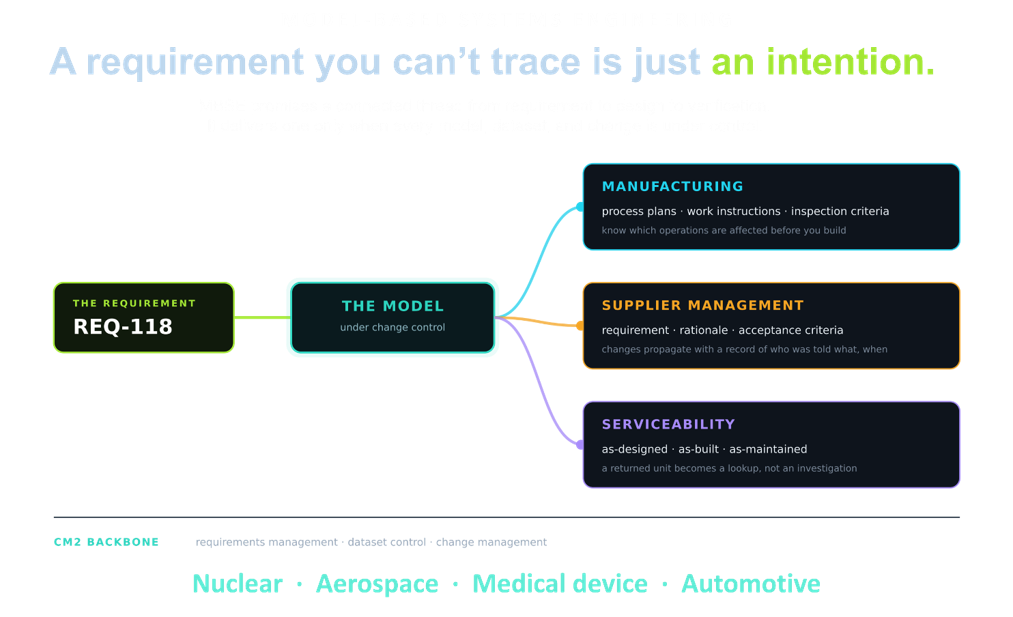
A requirement you can’t trace isn’t a requirement. It’s an intention.
MBSE promises a connected thread from requirement to design to verification. It delivers one only when every model, dataset, and change is under control. IPX makes that thread hold whether you are standing up MBSE for the first time or already modeling and need the configuration discipline to make the model authoritative.
Nuclear · Aerospace · Medical Device · Automotive
A model without change control is a model you can’t trust
Modeling tools are as process agnostic as every other tool. They will hold an elegant system model and tell you nothing about whether it matches the one manufacturing is building to, or the one the supplier quoted against. Without configuration and change management underneath, you don’t have a single authoritative model, you have several, disagreeing quietly.
Traceability is not a feature of the tool. It’s a discipline the tool can support.
Where traceability pays
- Manufacturing. Modeling requirements to flow through to process plans, work instructions, and inspection criteria. When a requirement changes, you know which operations, tooling, and inspections are affected — before you build, not during first article.
- Supplier management. Suppliers receive the requirement, its rationale, and its acceptance criteria rather than a drawing and a phone call. Changes propagate with a record of who was notified, when, and against which revision so a supplier building to superseded requirements becomes a preventable event.
- Serviceability. As-designed, as-built, and as-maintained stay connected. When a unit comes back from the field, you know its exact configuration and the requirements it was built to, which turns a diagnostic investigation into a lookup.
Two ways we engage
Starting out. We assess how systems engineering works today, define the modeling approach against your actual problem statements, build the requirements that drive tool selection, and support implementation. The same structured method we apply to any digital tool decision, and just as tool-agnostic.
Already modeling. We put the CM2 backbone underneath what you have: requirements management, dataset control, and change management, so the model becomes the authority instead of one more opinion in the room.
Why IPX
CM2-500 has defined the digital thread and twin since 1986, and requirements management, dataset control, and change management are three of its core business process categories. MBSE is where that thread gets modeled. This is not adjacent work for us. It is the discipline we maintain the standard for, applied to models.
In regulated environments, traceability isn’t a nice-to-have: you have to demonstrate the chain from requirement to verification evidence, on demand. We build the chain so it holds up when someone asks.
A supplier of safety-related components to operating reactors needed to demonstrate, on demand, that every delivered assembly matched its licensing-basis requirements. Change impact analysis was manual: a single design change meant tracing affected components, procedures, and inspection records by hand across multiple systems, taking weeks instead of days.
IPX establishes requirements traceability from the licensing basis through design, build records, and sustainment, with CM2 dataset control and change management underneath so each change carried its own record of what it touched.
Ready to get started?
Let's start with a conversation about where your organization is today and where the CM2 framework can take you.