January 6, 2026
Community Voice
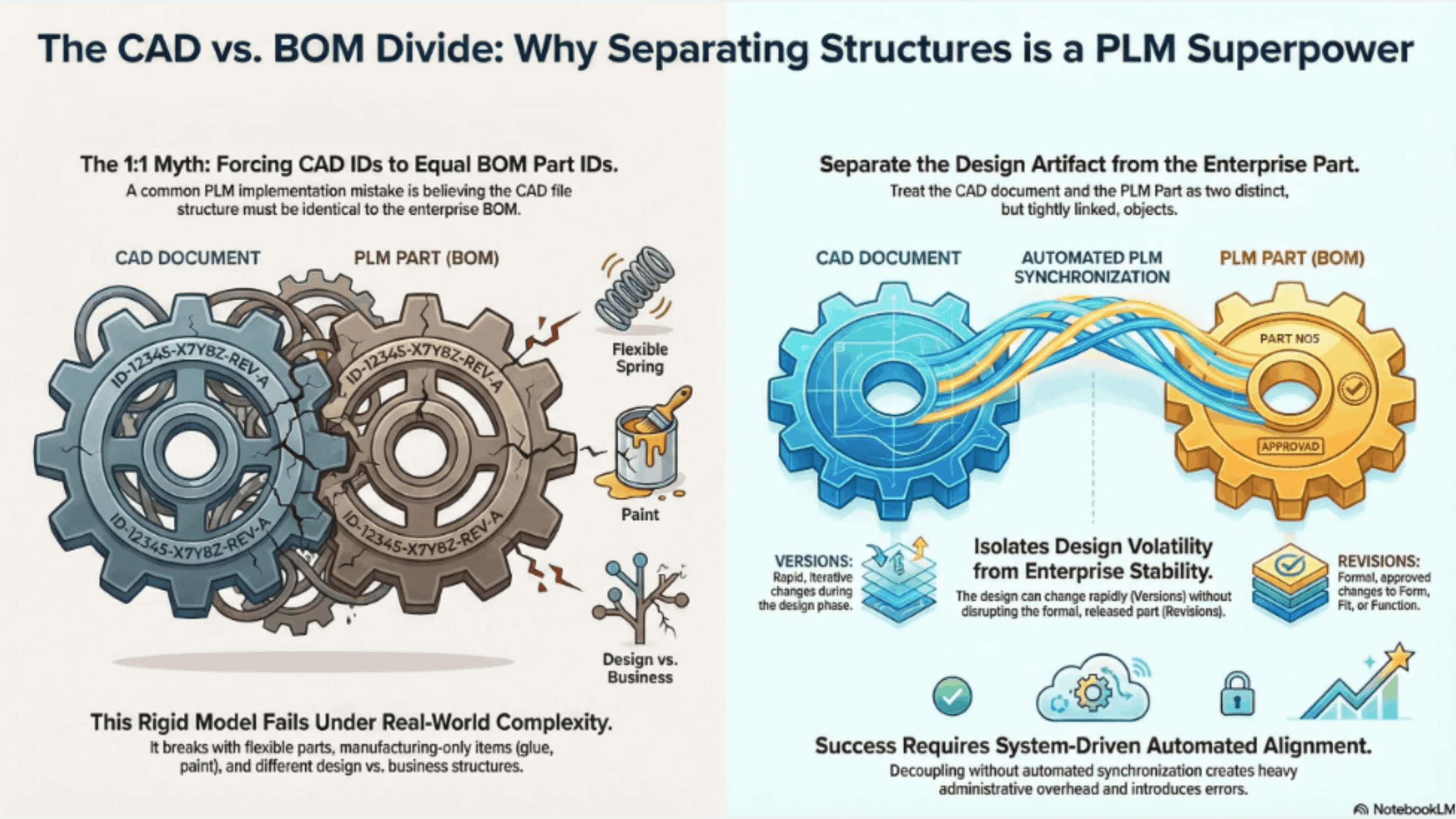

That question keeps popping up from time to time. For years, I’ve seen companies try to force a 1:1 link between CAD Model IDs and Part Numbers, and it always ends the same way: frustration, duplication, and inefficiency.
Recently, I talked to quite a few peers across different industries about why they have a 1:1 link between CAD and Parts. The answers might surprise you:
“Because it has always been like that.” -OR- “I don’t know why, because that was way before my time.”
None of them could explain a valid business reason for keeping it 1:1.
Today, I want to share why the winning strategy (especially for complex, multi-domain products) is decoupling CAD Model IDs from Part Numbers, and how embracing it can turn your PLM implementation from a single source of headaches into a competitive edge.
In many legacy or naïve PLM setups, there’s an assumption: “CAD part = PLM part”. You model a part in CAD, give it a name/ID, and that becomes the part number that flows through procurement, inventory, manufacturing, and service.
Seems simple, even elegant. But for complex products, often composed of mechanical, electrical, and software, that simplicity becomes brittle.
Treating both as the same object overlooks their different purposes and lifecycles.
As Anup Jain expressed in a Siemens blog: “managing design (CAD) and part content definition as a single integral item warrant a single lifecycle for design and part data … forcing multiple groups to compromise.”
That’s a frequent source of friction between designers, product engineers, manufacturing, procurement, and often why PLM implementations drag on, become rigid, or fail to scale.
The better (and increasingly accepted) architecture is to decouple:
This separation acknowledges that CAD Models, Parts, and Bill of Materials are fundamentally different data objects with different lifecycles, audiences, variation frequency, and purposes.
In short: treat CAD and parts as different but linked, and you get agility + stability.
Let me walk you through a few common headaches I’ve seen, especially in companies making complex, modular, multi-domain products:
In fact, some in the PLM community call the CAD = Part-ID assumption “one of the most common mistakes” in implementations. For instance, Jos Voskuil already mentioned this in a 2015 blog post, and Oleg Shilovitsky in a 2023 blog post.
Architectural decoupling is only half the story. If you treat CAD, Parts, and BoMs as separate spheres but manage them manually, you’ll trade one headache for another: administrative chaos, manual sync tasks, mistakes, and lost traceability.
That’s why you need system-driven alignment: a solution that supports:
Modern PLM systems are increasingly built around precisely this principle: treat CAD data, part/item data, and BoMs as different, yet linked, objects.
That way:
If you are a senior PLM or Configuration Management leader, a PLM/ERP architect, or a product-engineering lead considering PLM transformation, here’s what embracing decoupling + automated alignment can do for you:
In short, you get the best of both worlds: design freedom and enterprise stability.
If you have experience with Configuration Management frameworks, like CM2, you’ll recognize a few fundamental CM principles at work here:
By aligning PLM architecture with CM philosophy, you reduce risk, improve clarity, and keep complexity manageable even as product architecture scales in sophistication.
Architectural coupling (CAD ID = Part ID) feels neat and simple at first, but that simplicity is a trap. When product complexity grows, cross-domain interactions multiply, supply-chain demands increase, and time-to-market pressures tighten, that early “simplicity” becomes brittleness, chaos, and inefficiency.
By contrast, decoupling CAD from Part and empowering that separation with automated, system-driven alignment gives you both agility and stability.
If your organization is still stuck in the “one-structure-fits-all” mindset, consider this your permission, and your challenge, to move toward a modern, robust, scalable PLM architecture.
Use code Martijn10 for 10% off training—and don’t forget to tell them Martijn sent you 😉.
Copyrights by the Institute for Process Excellence
This article was originally published on ipxhq.com & mdux.net.

Known by his blog moniker MDUX—Martijn is a leading voice in enterprise configuration management and product lifecycle strategy. With over two decades of experience, he blends technical depth with practical insight, championing CM2 principles to drive operational excellence across industries. Through his blog MDUX:The Future of CM, his newsletter, and contributions to platforms like IpX, Martijn has cultivated a vibrant community of professionals by demystifying complex topics like baselines, scalability, and traceability. His writing is known for its clarity, relevance, and ability to spark meaningful dialogue around the evolving role of configuration management in Industry 4.0.


