December 2, 2025
Community Voice

If you’re smiling already, you know.
The truth is, Configuration Management is anything but calm. It’s structured chaos, full of acronyms, fueled by coffee, and kept going by determination. In truth, the Configuration Manager’s job description should probably come with a warning label and a cape.
Here’s what a real-world Configuration Manager’s job actually involves, including all the roles we play.
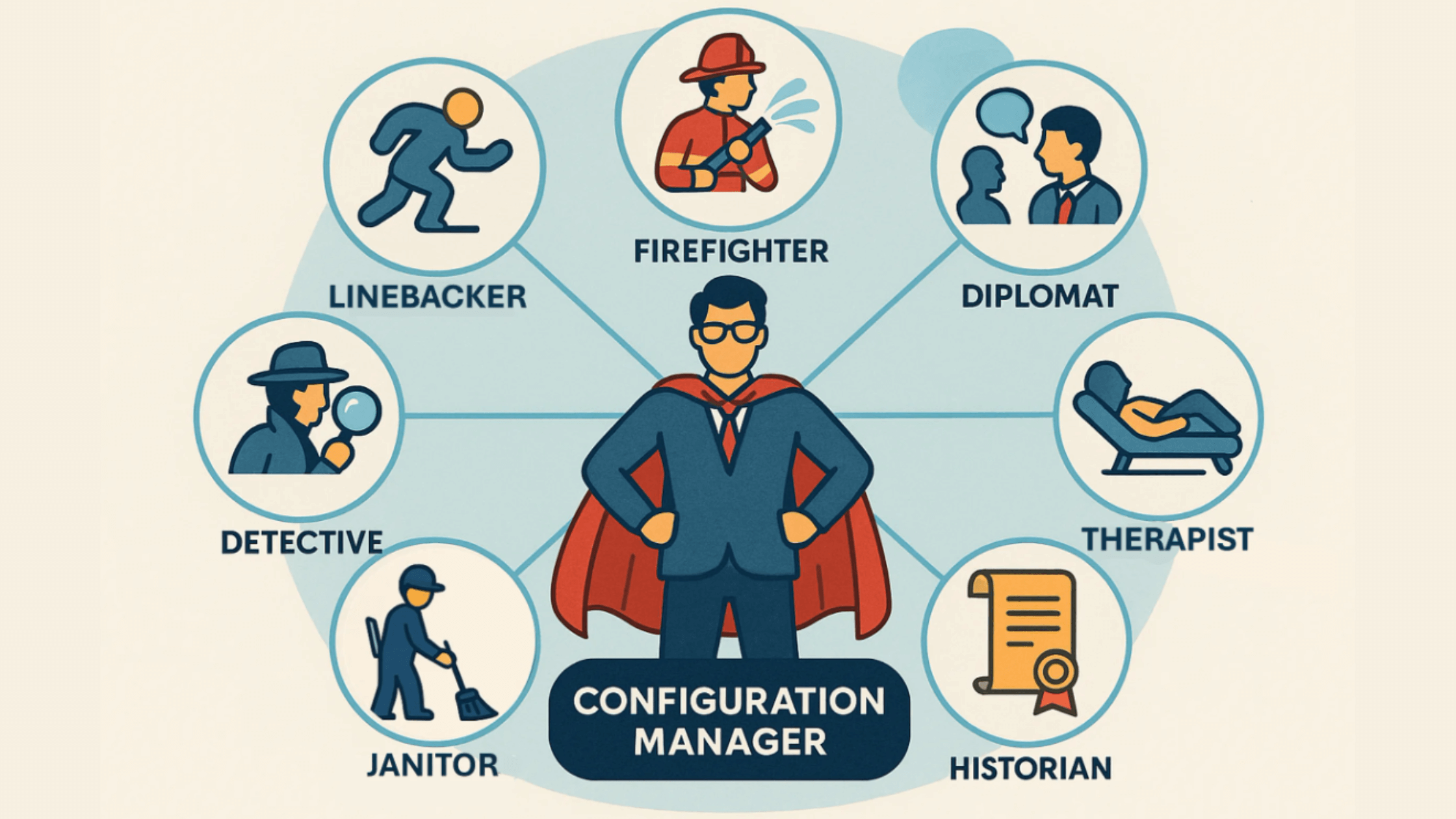
Have you seen Terry Tate, the Office Linebacker, tackling people who ignore office policy?
Now picture that same energy, but aimed at people who skip change control.
That’s us.
A Configuration Manager protects process integrity like a linebacker guards the end zone. Every “just a quick change,” “we’ll fix it later,” or “we didn’t think it was that big of a deal” feels like a direct attack on your baseline. You don’t want to be harsh, but you’ll stop that change if it skips review. Uncontrolled changes lead to failed programs, rising costs, and lost traceability faster than last Friday’s donuts disappeared.
So yes, part of our job is to enforce the rules with kindness. And sometimes, we use a clipboard as our shield.
Is something on fire? You run towards it right away. A last-minute engineering change threatens the production line. A supplier used the wrong drawing. The ERP and PLM systems are out of sync.
Sound familiar?
The Configuration Manager doesn’t just put out the fires. They figure out why it caught fire in the first place, document it, prevent it, and still make the 3 PM configuration review meeting look effortless. Configuration Managers are always ready. We don’t wonder if something will go wrong—we just ask where it will happen and how quickly we can fix it.
Configuration Management is where Engineering, Manufacturing, Quality, and Program Management meet, and none of them speaks the same language. You have to translate everyone’s needs, balance priorities, and keep the peace when each person thinks their change is the most urgent.
Managing configurations also means managing conflict. Diplomacy keeps the process moving forward without starting an interdepartmental civil war. You’re the calm voice that turns “We can’t do that!” into “Let’s explore how we can get back in control.”
Pro tip: Bring donuts to meetings. Diplomacy goes a lot smoother when you have snacks to share.
Ever had a design engineer confess that they “cut a corner that led to a non-conformance”? Or a project manager breaks down because the deadline is already visible in the rear-view mirror for a week? You’ve been there. As a CM professional, you’re part process expert, part counselor. You listen, acknowledge, and help teams navigate the process to regain control and traceability.
Your daily mantra?
“It’s okay, we’ll fix it through the closed-loop change process.”
And the therapeutic power of a well-structured Configuration Status Accounting report should not be underestimated.
Lost documents, conflicting part numbers, mysterious changes …
CM professionals often act like forensic investigators. You follow digital trails across PLM, ERP, and old shared drives. You dig into metadata and find out the reasons behind every change. Every configuration issue tells a story, and you’re the one who has to solve it before it becomes a quality escape or an audit nightmare.
If CSI and Sherlock Holmes had a baby that loved version control, it would be a Configuration Manager.
Yes, we clean up messes.
Legacy data. Outdated part numbers. Non-conformances. Change records with missing approvals. We sweep up behind the whirlwind of engineering brilliance and operational urgency, making sure the digital thread doesn’t look like a spaghetti diagram.
We take pride in the cleanup. Because a well-structured baseline is a beautiful thing, and in a world drowning in data, CM is the quiet force that brings order to the chaos.
Finally, the Configuration Manager is the keeper of truth, tracking the product’s DNA. We remember why choices were made, how baselines changed, and who approved each step. We save important knowledge in an industry that often starts over. When new team members ask, “Why do we do it this way?”, you have the records available to educate them.
A Configuration Manager enables the process of continual learning.
Configuration Management is really about trust.
CM professionals are the stewards of that trust. We create the foundation that allows innovation to thrive without chaos. So yes, we’re linebackers, firefighters, diplomats, therapists, detectives, janitors, and historians. But most importantly, we’re enablers of excellence.
In the CM2 world, we do more than control configuration. We design systems that make control sustainable. We set clear requirements, keep digital records connected, and make sure everything matches reality. Each CM professional has their own way of doing this.
So, I’ll end with a question for you:
Use code Martijn10 for 10% off training—and don’t forget to tell them Martijn sent you 😉.
Copyrights by the Institute for Process Excellence
This article was originally published on ipxhq.com & mdux.net.

Known by his blog moniker MDUX—Martijn is a leading voice in enterprise configuration management and product lifecycle strategy. With over two decades of experience, he blends technical depth with practical insight, championing CM2 principles to drive operational excellence across industries. Through his blog MDUX:The Future of CM, his newsletter, and contributions to platforms like IpX, Martijn has cultivated a vibrant community of professionals by demystifying complex topics like baselines, scalability, and traceability. His writing is known for its clarity, relevance, and ability to spark meaningful dialogue around the evolving role of configuration management in Industry 4.0.


